
Our key venues for arts and culture offer year-round cultural experiences.

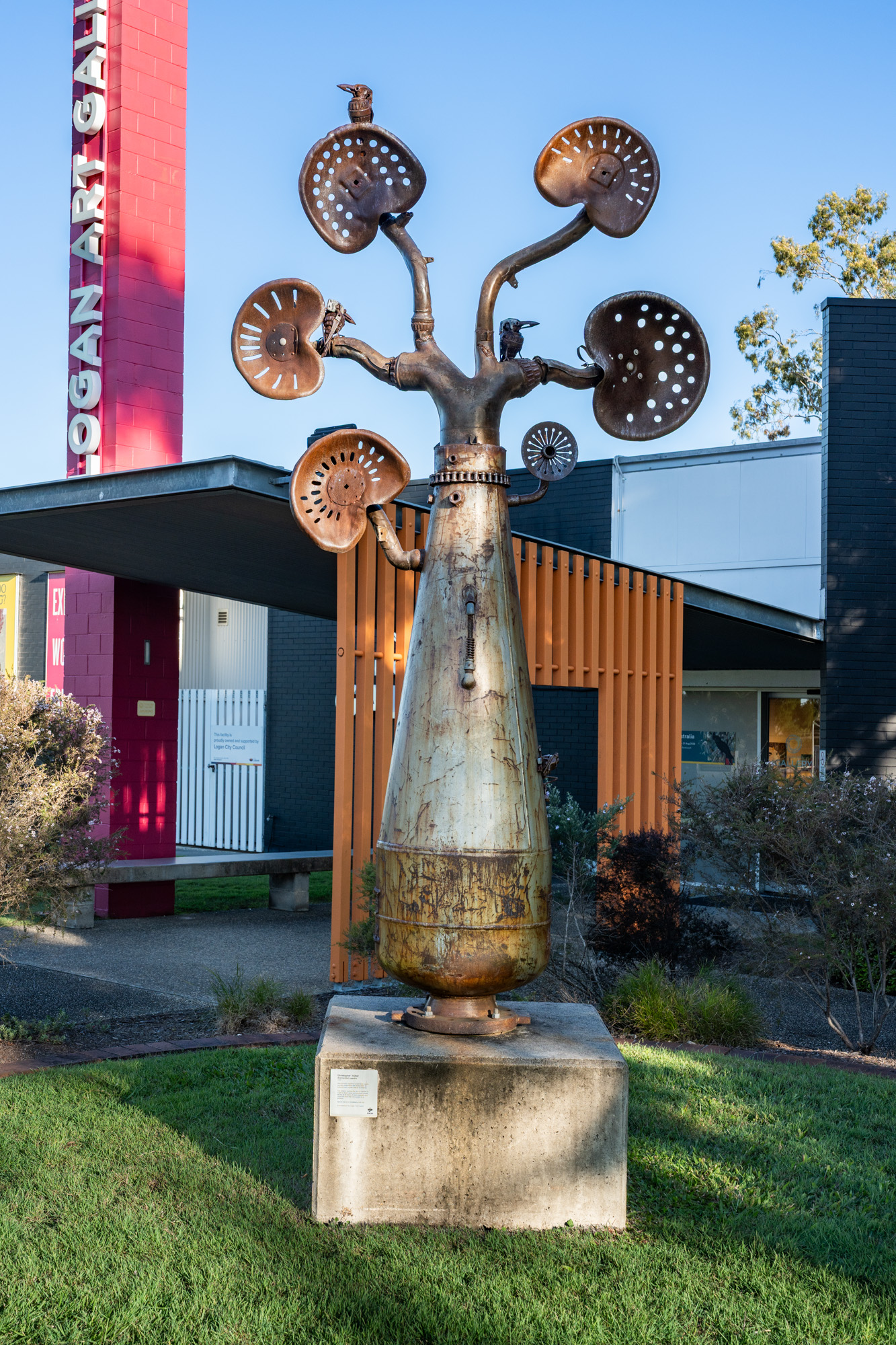
Brachychiton rupestris by Christopher Trotter, 2004
Brachychiton rupestris audio description, duration 3.4 minutes
The title of this artwork is Brachychiton rupestris, the botanical name for the Queensland Bottle Tree. It is by the artist Christopher Trotter, made in 2004. It is an outdoor sculpture of a bottle tree with four birds and a frog, located at the front of Logan Art Gallery, to the right of the entry as you approach. This artwork is constructed from recycled machine and metal parts sourced locally by the artist. Its surface is unpainted, tarnished, and worn. When touched, it feels rough, and it has been sealed with a clear surface sealer called X-troll to protect it from the elements. The sculpture measures approximately 3.3 metres high, 1.8 metres wide, and 60 centimetres deep. It is atop a square concrete plinth that is 55 centimetres high and 1 metre square.
The tree trunk is made of an upright industrial cyclone separator, its elongated cone-shaped form resembling the bulbous body of a bottle tree. The trunk narrows at the top and six branches splay out with three on each side. The top branches extend up, the middle branches extend out horizontally and the lower branches are shorter and point upwards. The branches are constructed from World War II radial aircraft exhaust manifolds and commercial water pipe bends. Each branch has a stylised leaf at its end. Five of the leaves are made from different vintage tractor seats positioned on their sides, each perforated with a pattern of small round or rectangular holes. The sixth leaf is smaller and located on the lower right branch when facing the gallery. It is circular and made from an automotive clutch‑plate spring. Just above this, an industrial chain collar wraps once around the top of the trunk. Also integrated into the top half of the trunk’s surface is a vertical stainless‑steel flexible hose.
Four birds inspired by kookaburras, with long, narrow beaks and closed wings, perch on the tree facing different directions. When facing the gallery, two birds are positioned at the end of the middle-left branch while the third bird is on the top left branch at the edge of the tractor-seat leaf. The last bird is positioned on the middle-right branch near the trunk. The birds are roughly life size and built from automotive bearings, fan blades, door latches, and finger tines. The final detail is a frog, located on the lower half of the trunk, on the right-hand side. It is about the size of a large, outstretched hand and features Holden engine rocker body components. The artist has signed the work ‘C. Trotter 04’ vertically in capital letters using solder along a seam on the left-hand side of the trunk.
For Christopher Trotter, scrap metal and industrial discards form the basis of his distinctive and evocative works. He carefully selects and composes the materials to give each work its own ‘personality’, while promoting recycling through creative solutions to the challenges of resource renewability. Trotter examines the classic Australian culture of ‘making do’, in a whimsical, inventive, and entertaining way, encouraging interaction with his works. The artist acknowledges and thanks Sims Metal and X-troll and this artwork was commissioned by Logan City Council.
Image credit: Christopher Trotter, Brachychiton rupestris, 2004, recycled machine and metal parts, image courtesy Logan Art Gallery and Louis Lim